

BAHAI THINKING II
BAHA'U'LLAH?
 |
|
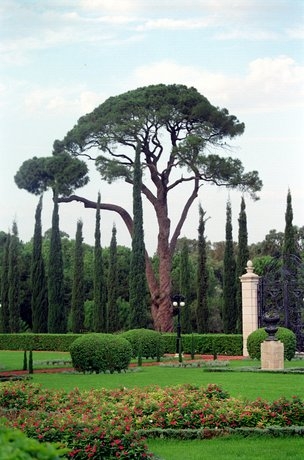
In the Holy Gardens of Bahji, Akko, Israël |
In the spring of 1863 on the banks of the River Tigris in Baghdad, events took place which lie beyond the common imagination. Only the companions of a nobleman who had been exiled by the Shah of Persia to the land of the Sultan of the Ottoman Empire were close to the mystical circumstances in which the Spirit of God manifested Himself in the rose garden of Ridván, called by Bahá'u'lláh "the Paradise". That exhilarating moment is rooted in a dramatic history.
The Persian government had, in 1850, brought a thirty-one year old reformer from Shiráz, the City of Poets, in front of a firing squad. His name was Mírza 'Ali Muhammad called The Báb. On May 23, 1844, He first revealed to a seeker that God had chosen him to be the sealer of the past, the opener of the gate to the future. A new era for humankind was at hand, the Báb announced, in which the children would be more learned than the scholars of the Koran. And, through the operation of God, man's inner and outer world would be transformed into a higher civilization, beyond Islam.
In Persia "a storm of hope and exaltation" had risen through the Revelation of the Báb Who, by hundred thousands of Persians, was seen as the return of the Hidden Imam, the Sign of the Day of Judgment, when the thinking and doing of mankind would be purified by the Hand of God Almighty.The Báb Himself saw His mission in the context of an even greater event, namely, the coming of the Promised One of all religions, "Him Whom God shall make manifest".
At the time, the media in the West reported that the Persian Shi'ah divines had unleashed their power against the religious movement of the Báb. Thousands of His followers lost their lives and property through the cruel persecutions by Muslim extremists in the ravaged cities and towns of the land. They were the first martyrs of a renewal of religion that since then has spread over the whole of the earth, while still suppressed in the land of its origin.
Among the followers of the Báb there was a nobleman named Mírza Husayn 'Ali of Núr, a descendant of an old Persian family of courtiers and landowners from the foothills by the Caspian Sea. The Núrí family tree dated back to the pre-Islamic kings of Persia, with a legendary relationship to King David. In the weeks before His execution in the city of Tabriz, the Báb, had sent, through an emissary, His pen, His signet ring and His last writings to this high-ranking aristocrat.
Soon thereafter Mírza Husayn 'Ali, the receiver of the Bab's holy memorabilia, was dragged into the pogroms which terrorized Persia. In 1852 his persecutors threw Him into the black pit of the state's dungeons under old Tehrán. In the heart-rending distress of that horrible place the prisoner of the Sháh and the divines, then 35 years old, with feet in a block and bent under a heavy iron chain, was called by the Almighty to reveal His Will.
"And He bade Me lift up My Voice between heaven and earth", He later wrote to the Persian king.
In the years to come, he took the name that would become known in history: Bahá'u'lláh, meaning "Glory of God".
Following His release from prison, Bahá'u'lláh went into exile for forty years. A caravan of outcasts, with Bahá'u'lláh as their Leader, eventually reached the coastal plains north of Mount Carmel in the Holy Land, the Valley of Esdralon. The Carmel ("Armageddon" = Hill of Meggido) is the location in the Revelation of St. John of the final contest between God and "evil forces", a mystic struggle in the "time of the end", a biblical metaphor for the present age.
From one of the places of exile, Adrianople in the European part of Turkey, Bahá'u'lláh announced Himself to Queen Victoria, Czar Alexander II, Emperor Wilhelm I, Napoléon III of France and Pope Pius IX as the Promised One of all ages. He condemned the arms race of their governments and called for a system of world security in which all nations would join together to defend peace forever.
The nations had to agree over a common language, over universal systems and standards, a global arrangement of law and order, and a worldwide network for mutual development. And while East and West witnessed the rise of nationalism, Bahá'u'lláh had already taught, at the close of the 19th century, of the need to love the whole world rather than loving only one's country.
For forty years - from 1852 to 1892 - the Prophet of the Millennium was a Prisoner of the mightiest rulers of the Middle East. He opposed His enemies as "a mountain". Whosoever came near to Him, appeared "dismayed and confused and could not began to speak". And He sacrificed His prestige, health, freedom, well-being and all His possessions in the path of His calling as a Manifestation of God.
Bahá'u'lláh had revealed more than a hundred Tablets, and numerous prayers, meditations and epistles, as the spiritualizing result of the most powerful intervention of God in history. On this sacred foundation the first planetary civilization shall come to being, a life-supporting system in which all known forms of government and rule over mankind would be gathered together into a universal order, the Kingdom of God for which millions of Christians pray daily in the Our Father.
In his biography of Bahá'u'lláh, the Iranian-born writer and spiritual teacher, Hasan Balyuzi, mentions the difficulty of describing the phenomenon of God manifesting Himself in the perception of man.
"The towering grandeur, the compelling majesty, and the tender beauty of the life of a Manifestation of God cannot be comprehended by events usually associated with a saintly life. The immensity of such a life presents itself in that mysterious influence which it exerts over countless lives - an influence which does not function through social status and prestige, wealth, secular power or worldly dominion, indeed not even through the medium of superior knowledge and the force of intellectual achievement. The Manifestation of God is the Archetype, and His life is the supreme pattern. His vision, not arrested by time and space, encompasses the future as well as the past. He is the only and the necessary link between one cycle of social evolution and another. Without Him history is meaningless and co-ordination is impossible."
Q U O T A T I O N
Extract from "God Passes By"
by Shoghi Effendi, late Guardian of the Bahá'í Faith
To Israel He was neither more nor less than the incarnation of the "Everlasting Father", the "Lord of Hosts"come down "with ten thousands of saints"; to Christendom Christ returned "in the glory of the Father," to Shí'ah Islam the return of the Imam Husayn; to Sunni Islam the descent of the "Spirit of God" (Jesus Christ); to the Zoroastrians the promised Shah-Bahram; to the Hindus the reincarnation of Krishna; to the Buddhists the fifth Buddha.
He alone is meant by the prophecy attributed to Gautama Buddha Himself, that "a Buddha named Maitreye, the Buddha of universal fellowship" should, in the fullness of time, arise and reveal "His boundless glory." To Him the Bhagavad-Gita of the Hindus had referred as the "Most Great Spirit," the "Tenth Avatar," the "Immaculate Manifestation of Krishna."
To Him Isaiah, the greatest of the Jewish prophets, had alluded as the "Glory of the Lord," the "Everlasting Father,"the "Prince of Peace," the "onderful," the "Counsellor," the "Rod come forth out of the stem of Jesse" and the "Branch grown out of His roots," Who "shall be established upon the throne of David," Who "will come with strong hand," Who "shall judge among the nations," Who "shall smite the earth with the rod of His mouth, and with the breath of His lips slay the wicked," and Who "shall assemble the outcasts of Israel, and gather together the dispersed of Judah from the four corners of the earth."
To Him Jesus Christ had referred as the "Prince of this world," as the "Comforter" Who will "reprove the world of sin, and of righteousness, and of judgment," as the "Spirit of Truth" Who "will guide you into all truth," Who "shall not speak of Himself, but whatsoever He shall hear, that shall He speak," as the "Lord of the Vineyard," and as the "Son of Man" Who "shall come in the glory of His Father". "in the clouds of heaven with power and great glory," with "all the holy angels" about Him, and "all nations" gathered before His throne.
In concluding of this theme, I feel, it should be stated that the Revelation identified with Bahá'u'lláh abrogates unconditionally all the Dispensations gone before it, upholds uncompromisingly the eternal verities they enshrine, recognizes firmly and absolutely the Divine origin of their Authors, preserves inviolate the sanctity of their authentic Scriptures, disclaims any intention of lowering the status of their Founders or of abating the spiritual ideals they inculcate, clarifies and correlates their functions, reaffirms their common, their unchangeable and fundamental purpose, reconciles their seemingly divergent claims and doctrines, readily and gratefully recognizes their respective contributions to the gradual unfoldment of one Divine Revelation, unhesitatingly acknowledges itself to be but one link in the chain of continually progressive Revelations, supplements their teachings with such laws and ordinances as conform to the imperative needs, and are dictated by the growing receptivity, of a fast evolving and constantly changing society, and proclaims its readiness and ability to fuse and incorporate the contending sects and factions into which they have fallen into a universal Fellowship, functioning within the framework, and in accordance with the precepts, of a divinely conceived, a world-unifying, a world-redeeming Order.
LINKS
